Boat and Yacht Maintenance within the Indonesian Maritime Jurisdiction
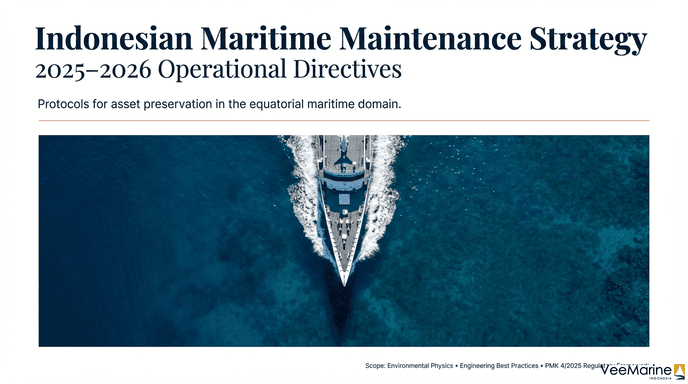
The Equatorial Maritime Maintenance Paradigm
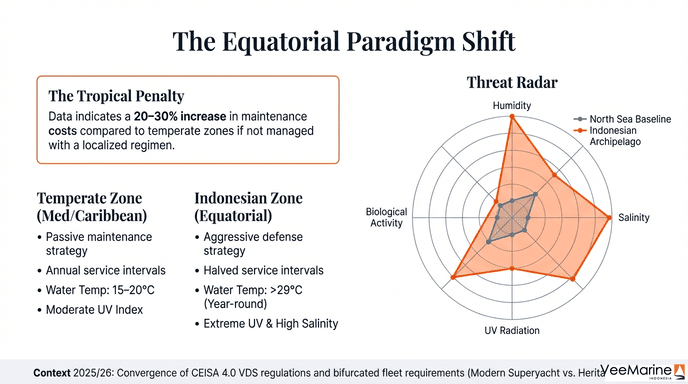
The operation and maintenance of marine vessels within the Indonesian archipelago represent a distinct technical discipline, divergent significantly from the standards established in temperate maritime zones such as the Mediterranean or North America. Indonesia, the world’s largest archipelagic state, spans the equator with over 17,000 islands, creating a maritime domain characterized by year-round high humidity, intense ultraviolet radiation, and water temperatures consistently exceeding 29°C. For vessel owners, fleet managers, and captains, this environment necessitates a shift from passive maintenance schedules to aggressive, proactive asset preservation strategies.
The period of 2025–2026 marks a pivotal evolution in this sector. The convergence of tightening regulatory frameworks—specifically the introduction of the CEISA 4.0 Vessel Declaration System and revised import taxation laws (PMK 4/2025)—with an expanding yet fragmented infrastructure creates a complex operational landscape. Simultaneously, the market is bifurcating into two distinct maintenance methodologies: the preservation of modern composite/metal superyachts and the specialized husbandry of the indigenous Phinisi fleet, a UNESCO-recognized heritage requiring distinct artisanal skills.
This report provides an exhaustive technical analysis of the maintenance requirements for vessels operating in Indonesia. It synthesizes environmental data, engineering best practices, legal compliance protocols, and logistical strategies into a cohesive framework. The findings indicate that the “tropical penalty”—the accelerated degradation of materials in this region—can increase maintenance costs by 20–30% compared to temperate regions if not managed with a specialized, localized regimen.
2. The Tropical Maritime Environment: Thermodynamics and Bio-Chemical Stressors
To understand the accelerated wear rates observed in Indonesian waters, one must first analyze the foundational environmental stressors. The archipelago acts as a massive heat reservoir, driving chemical and biological processes at rates significantly higher than in higher latitudes.
2.1 The Thermodynamics of Corrosion in High-Salinity, High-Temperature Waters
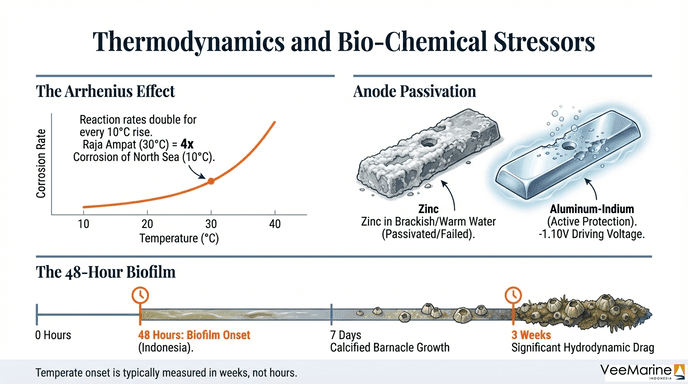
The fundamental challenge in Indonesian waters is the electrochemical activity of the sea itself. The rate of chemical reactions, including oxidation (rust) and galvanic corrosion, is governed by the Arrhenius equation, which roughly dictates that reaction rates double for every 10°C rise in temperature. In the context of marine metals, the differential between a 10°C North Sea harbor and a 30°C anchorage in Raja Ampat implies a theoretical quadrupling of corrosion rates.
2.1.1 Galvanic Corrosion and Anode Passivation
In this hyper-conductive environment, the behavior of sacrificial anodes changes. Standard zinc anodes, the industry staple in cooler waters, frequently fail in Indonesia due to “passivation.” In warm, organic-rich, or brackish waters—common in Indonesian estuaries like Jakarta Bay or the rivers of Kalimantan—zinc tends to form a coherent coating of zinc oxide/hydroxide. This crust electrically insulates the anode, rendering it inactive while the vessel’s cathode (propellers, shafts, through-hulls) remains unprotected.
Recent metallurgical analyses suggest that Aluminum-Indium (Al-In) anodes are the superior choice for the Indonesian archipelago. Aluminum anodes possess a higher driving voltage (-1.10V vs. -1.03V for Zinc) and a higher amp-hour capacity per kilogram, allowing them to punch through the resistance of brackish water and remain active longer in tropical temperatures. Fleet managers operating in the region report that converting to Aluminum anodes has reduced underwater metal wastage by approximately 40% over a 24-month cycle.
2.2 Biofouling Pressures in the Coral Triangle
Indonesia sits at the heart of the Coral Triangle, the global epicenter of marine biodiversity. While this makes it a premier cruising destination, it presents a formidable challenge for hull husbandry. The biodiversity of fouling organisms—barnacles, tunicates, bryozoans, and algae—is unparalleled.
2.2.1 Growth Rates and Mechanisms
In temperate zones, a vessel might remain relatively clean for weeks. In benign Indonesian anchorages, the onset of soft fouling (biofilm) occurs within 48 to 72 hours. This biofilm serves as a substrate for macro-fouling larvae. Hard growth, such as barnacles (Amphibalanus spp.) and tubeworms (Serpulidae), can establish a calcified foothold within 7 to 10 days.
The “Nutrient Trap” phenomenon exacerbates this issue. Many key logistical hubs, such as Batavia Marina in Jakarta or Benoa Harbour in Bali, are located in estuarine environments where nutrient-rich freshwater runoff mixes with warm seawater. This creates a hyper-productive zone for marine growth. Vessels static in these locations for more than two weeks will experience significant fouling that compromises hydrodynamic efficiency, increasing fuel consumption by up to 20% due to drag.
2.3 Monsoon Meteorology and Maintenance Windows
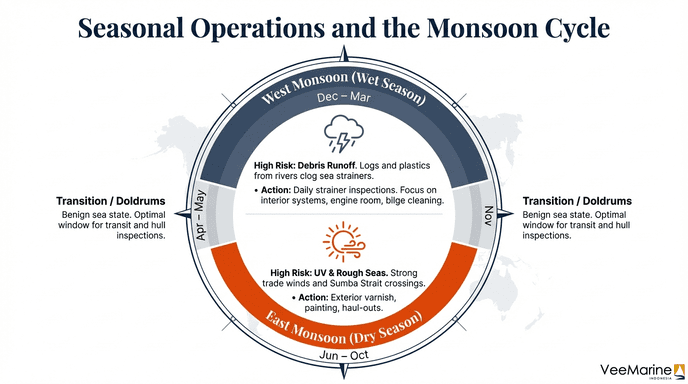
Maintenance planning in Indonesia is inextricably linked to the monsoon cycle. The archipelago’s weather is dominated by two primary seasons, the West Monsoon and the East Monsoon, separated by transition periods. Ignoring these cycles can lead to catastrophic scheduling failures, particularly for exterior works like painting or varnishing.
| Monsoon Phase | Duration | Prevailing Winds | Atmospheric Conditions | Maintenance Implications & Risks |
| West Monsoon (Wet Season) | December – March | West / Northwest | High humidity (>85%), frequent heavy rainfall, squalls. | Critical Risk: River runoff brings logs and plastic debris; sea strainers clog daily. Focus: Interior systems, engine room, bilge cleaning. Avoid: Exterior painting/varnishing due to moisture. |
| Transition Period I | April – May | Variable | Decreasing rainfall, calm seas (“Doldrums”). | Optimal Window: Ideal for haul-outs, short transits, and hull inspections. Sea state is generally benign. |
| East Monsoon (Dry Season) | June – October | East / Southeast | Strong, steady Trade Winds, lower humidity, high UV. | Optimal Window: Exterior varnish, gelcoat repair, deck work. Risk: Rough seas in southern crossings (e.g., Sumba Strait, Timor Sea) causing structural stress. |
| Transition Period II | November | Variable | Rising humidity, decreasing wind, heat build-up. | Focus: Service Air Conditioning and Gensets in preparation for Wet Season loads. |
Insight: The “Wet Season” poses a specific, often overlooked threat: marine debris. Heavy rains flush the interiors of islands like Java and Bali, sending massive volumes of bamboo, logs, and plastics into the coastal waters. During December and January, the risk of clogged raw water intakes increases exponentially. Captains must transition from weekly to daily strainer inspections to prevent engine overheating.
3. Hull Husbandry: Divergent Methodologies for Modern and Traditional Vessels
The Indonesian maritime fleet is a dichotomy of modern GRP/Steel superyachts and traditional wooden Phinisi schooners. Each requires a fundamentally different maintenance philosophy.
3.1 Modern Hull Maintenance (GRP, Steel, Aluminum)
3.1.1 Antifouling Paint Chemistry for the Tropics
The global shift towards eco-friendly, low-biocide antifouling paints presents a challenge in Indonesia’s aggressive fouling environment. Paints formulated for the Mediterranean or Caribbean often underperform here, leading to premature fouling.
- Ablative vs. Hard Matrix: For vessels that are active and cruising (e.g., charter yachts moving between Komodo and Raja Ampat), Self-Polishing Copolymer (SPC) paints are recommended. These rely on hydrolysis to release fresh biocide. The warm water accelerates this chemical reaction, meaning a paint thickness designed for 24 months in Europe may deplete in 14 months in Indonesia.
- Hard Antifouling: For vessels that spend long periods at anchor (e.g., liveaboards in Sorong awaiting guests), Hard Antifouling is often superior. It withstands the frequent mechanical scrubbing required by divers to remove hard growth without stripping the paint entirely.
- Tropical Specification: It is imperative to source paints specifically “tropicalized” or with higher copper/biocide loads (e.g., International Micron Extra 2, Jotun SeaQuantum). Applying a temperate-spec paint is a false economy that will necessitate an emergency mid-season haul-out.
3.1.2 Osmosis Mitigation
The kinetic energy of water molecules at 30°C is significantly higher than at 15°C, increasing the rate of water permeation into polyester resin (osmosis). Older GRP vessels imported into Indonesia are highly susceptible. Regular maintenance must include hauling out to allow the hull to dry, though the high humidity makes natural drying slow. The use of dehumidifiers and tenting during blister repair is mandatory to achieve acceptable moisture readings before re-coating.
3.2 The Phinisi: Maintenance of a Living Heritage
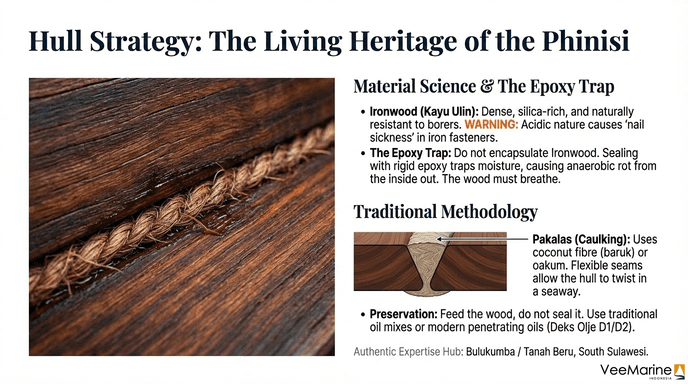
The Phinisi is not merely a boat style; it is a UNESCO Intangible Cultural Heritage. Its construction relies on oral traditions from Bulukumba, South Sulawesi, and its maintenance requires adherence to specific material sciences that defy modern fiberglass logic.
3.2.1 Material Science: Ironwood (Kayu Ulin) and Teak
- Ironwood (Eusideroxylon zwageri): The primary hull material. It is extremely dense, sinks in water, and is naturally resistant to marine borers due to high silica and oil content. However, this oil content makes it difficult to glue with modern epoxies. It is acidic and can corrode standard iron fasteners (“nail sickness”).
- Teak (Tectona grandis): Used for decks and superstructure. The intense UV in Indonesia causes rapid photo-degradation (graying) and erosion of softer grain (washboarding).
3.2.2 Traditional Caulking (Pakalas) vs. Modern Sealants
A common and catastrophic error made by new owners refitting Phinisies is attempting to seal the hull with rigid epoxy or fiberglass sheathing. Phinisi hulls are designed to be flexible; they twist and “work” in a seaway.
- The Mechanism: Traditional caulking uses baruk (coconut fiber) or oakum driven into the wedge-shaped seams between planks. This material is flexible and expands when wet.
- The Maintenance Ritual: The caulking is not permanent. It must be inspected and “hardened up” (re-driven) regularly. When a wooden boat is launched after a dry-docking, it will leak significantly for several days until the wood swells and “takes up.” This is a normal, managed process, not a failure.
- The Epoxy Failure: Encapsulating an Ironwood hull in fiberglass traps moisture. Since the wood cannot breathe, the internal moisture content rises, creating an ideal environment for anaerobic rot fungi. This leads to the hull rotting from the inside out, often undetected until structural failure occurs.
3.2.3 Indigenous Wood Preservation Techniques
Traditional Bugis boatbuilders utilize specific recipes to preserve wood that are highly effective in this climate. A common mixture involves a ratio of diesel fuel and used motor oil (1:1), sometimes infused with natural resins or pitch. While this provides excellent resistance against termites and rot, it is aesthetically dark and environmentally controversial. Modern luxury Phinisies are transitioning to high-grade penetrating oils (e.g., Deks Olje D1/D2) which mimic the “feeding” properties of the traditional mix but offer a superior finish. The key principle remains: feed the wood, do not seal it.
4. Mechanical and Electrical Systems Engineering in the Tropics
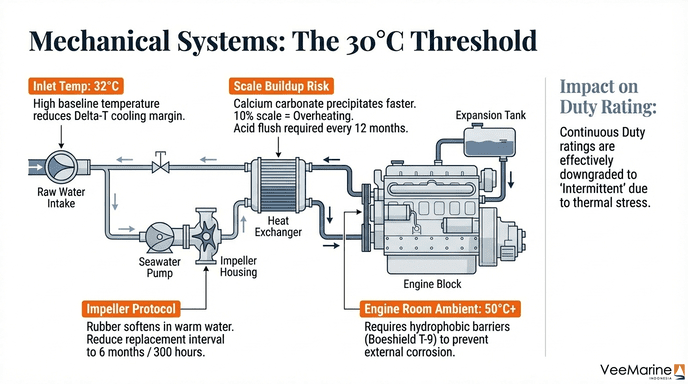
The thermodynamic reality of Indonesia—high ambient air temperature (often 35°C+ in engine rooms) and high seawater temperature (30°C+)—derates the efficiency of almost all mechanical systems. Equipment rated for “continuous duty” in Northern Europe may effectively become “intermittent duty” in Indonesia.
4.1 Cooling Systems: The 30°C Threshold
Marine diesel engines and generators are typically designed with a delta-T ($\Delta T$) based on 20-25°C raw water. In Indonesia, the raw water inlet temperature is often 30-32°C.
- Reduced Cooling Margin: The thermal headroom is significantly reduced. A heat exchanger with 10% scale fouling, which might be negligible in Norway, can cause immediate overheating in Raja Ampat.
- Impeller Service Life: Rubber impellers degrade faster in warm water. They harden, crack, and lose flexibility. The standard annual replacement interval must be shortened to every 6 months or 300 hours to prevent failure.
- Chemical Descaling: Calcium carbonate precipitates more readily from warm seawater. The cooling loop (heat exchangers, oil coolers, gearbox coolers) requires circulation with a descaling acid (e.g., phosphoric acid or specialized fluids like Barnacle Buster) every 12 months. This is double the frequency recommended in temperate climates.
4.2 Air Conditioning: The Critical Lifestyle System
On a luxury yacht in Indonesia, the Air Conditioning (AC) system is mission-critical. Failure results in immediate habitability issues and rapid interior deterioration due to mold.
- Load Calculations: Systems sized for the Mediterranean often struggle to maintain an interior temperature of 22°C when the exterior is 32°C with 90% humidity. The latent cooling load (humidity removal) is massive.
- Biofouling in Lines: In nutrient-rich anchorages (e.g., Serangan, Ambon), AC cooling lines can become fouled with barnacles and mussels inside the hoses, restricting flow. Installing a sea chest or redundant sea strainers that can be cleaned without shutting down the system is a recommended upgrade.
- Mold Mitigation: The high humidity makes ducting prone to mold. Ultraviolet (UV-C) sterilization lights installed in the air handlers are increasingly standard on yachts refitted for the region to maintain air quality.
4.3 Fuel Quality and Management
Indonesian diesel fuel (Biosolar/Solar) poses specific challenges due to its biodiesel content (B30 to B35 mandates).
- Hygroscopic Nature: Biodiesel attracts and holds water. In the humid tropical air, condensation in fuel tanks is inevitable. The water-fuel interface is the breeding ground for the “diesel bug” (microbial contamination), which produces sludge that clogs filters.
- Filtration Strategy:
- Biocides: Routine dosing of fuel tanks with biocides is mandatory at every bunkering.
- Polishing: Installation of an independent fuel polishing system to circulate and filter fuel is highly recommended, especially for vessels bunkering in remote ports (e.g., Labuan Bajo, Sorong) where fuel may be delivered via drums or barges with questionable cleanliness.
- Inventory: Vessels should carry at least triple the standard inventory of primary (Racor) filters. 30-micron elements are standard for the first stage to catch the bulk of the asphaltines and sludge.
5. Regulatory and Legal Framework: 2025/2026 Updates
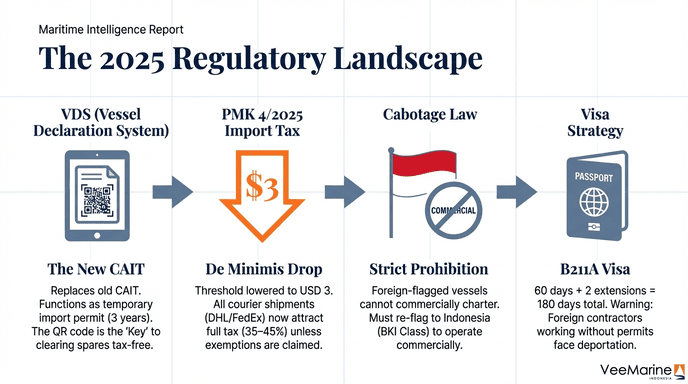
Navigating the Indonesian regulatory landscape is as critical as navigating its reefs. The legal environment for foreign yachts has evolved significantly, with new systems introduced in 2025 affecting vessel entry, stay, and maintenance logistics.
5.1 The Vessel Declaration System (VDS) and Customs
The historic CAIT (Clearance Approval for Indonesian Territory) system has been replaced by the Vessel Declaration System (VDS), managed through the CEISA 4.0 platform.
- Mechanism: The VDS acts as a temporary import permit, allowing foreign yachts to stay in Indonesia for up to 3 years without paying import taxes. Registration is digital and must be completed prior to entry.
- Maintenance Implication: The VDS document is the “Key” to accessing tax-exempt status for “ship’s spares in transit.” Without a valid, printed VDS with a QR code, Customs will treat any imported spare part as a general import, attracting full duties and taxes. Captains must ensure their VDS is always active and accurate regarding the vessel’s specifications.
5.2 The 2025 Import Tax Regime (PMK 4/2025)
As of 2025, the Ministry of Finance has updated import regulations (PMK 4/2025), significantly lowering the de minimis value (tax-free threshold) for personal shipments to USD 3. This effectively means all yacht spare parts imported via courier (DHL, FedEx) are subject to full taxation unless specific exemptions are successfully claimed.
- Duty Structure:
- Import Duty (BM): 7.5% – 15% (HS Code dependent).
- Value Added Tax (PPN): 11% (Scheduled to rise to 12% for luxury goods categories).
- Income Tax (PPh): 7.5% – 10% (can be 20% without a tax ID).
- Total Burden: A typical spare part can attract a total tax burden of 35–45% of its CIF (Cost, Insurance, Freight) value.
5.3 Visa Regulations for Maintenance Crews
Foreign crew typically utilize the B211A Visit Visa (60 days, extendable twice for a total of 180 days).
- Work vs. Maintenance: Indonesian Immigration is strict regarding “work.” Crew performing maintenance on their own vessel is generally permitted. However, bringing in foreign contractors (e.g., a specialist electronic engineer from Singapore) to work on the boat without a proper work permit is illegal and carries heavy fines and deportation risks. For major specialized repairs, it is often safer to sail the vessel to Singapore or Darwin, or engage a local agent to sponsor the technician’s specialized visa.
5.4 Cabotage and Chartering Restrictions
Foreign-flagged yachts are strictly prohibited from engaging in commercial chartering (Cabotage Law). They cannot sell trips or carry paying passengers between Indonesian ports.
- Maintenance Funding: This restriction means foreign owners cannot legally offset maintenance costs by chartering locally. To charter, the vessel must be re-flagged to Indonesia and meet Indonesian BKI Class survey standards, which often requires significant structural modifications compared to recreational standards (e.g., fire bulkheads, stability requirements).
6. Logistics and Supply Chain Management
The “tyranny of distance” combined with protectionist trade policies makes logistics the single greatest frustration for yacht maintenance in Indonesia.
6.1 The “Red Line” Inspection Protocol
Indonesia Customs operates a risk-based “Red Line / Green Line” system. High-value items, irregular shipments, and yacht spares almost invariably fall into the “Red Line,” mandating physical inspection.
- The Delay: A “Red Line” inspection can add 7–14 days to the clearance process. Parts labeled generically as “Boat Parts” attract scrutiny.
- Strategy: Use specific industrial descriptions and HS Codes (e.g., “Centrifugal Water Pump” instead of “Boat Pump”).
6.2 The Yacht Agent Ecosystem
Attempting to clear parts independently is a recipe for indefinite delays. The most effective strategy is to engage a specialized yacht agent (e.g., Kokoba Marine, Eighth Degree South, Asia Pacific Superyachts).
- Role: These agents hold the necessary Import Licenses (API) and relationships with Customs to clear “Ship’s Spares in Transit.”
- Cost vs. Time: Agents typically charge a handling fee (10–15% of value) plus the taxes. While expensive, it buys certainty. A part stuck in Jakarta Customs for 4 weeks can cost more in lost cruising time than the agent’s fee.
6.3 Sourcing Strategies
- Singapore Hub: Singapore is the logistical lung for the Indonesian yachting scene. It is often faster and cheaper to fly a part from Europe/USA to Singapore, and then have a crew member fly to Singapore to retrieve it as personal baggage (within legal limits), or use a specialized “hand-carry” courier service to Batam or Bali.
- Domestic Industrial Sourcing: Surabaya and Jakarta are massive industrial hubs. Many “marine” parts (bearings, seals, hydraulic hoses, electric motors, filters) are standard industrial components. Sourcing them from local industrial suppliers (e.g., PT. Surya Putra Mesindo in Jakarta) can save 50–70% compared to importing “marine branded” versions, with zero customs delay.
- Local Fabrication: Indonesian craftsmanship in stainless steel and wood is world-class. Fabricating tanks, bimini frames, or teak decking locally is often superior to importing.
7. Strategic Infrastructure: Marina and Shipyard Analysis
Indonesia’s maritime infrastructure is developing rapidly but remains geographically concentrated. Understanding the capabilities of each hub is vital for voyage planning.
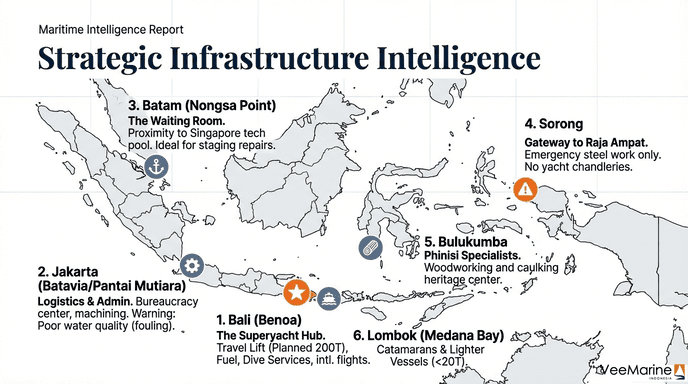
7.1 Key Maintenance Hubs and Capabilities
| Location | Facility | Haul-Out Capacity | Key Capabilities | Strategic Value |
| Bali (Benoa) | Benoa Marina / Bali Marina | Travel Lift (Planned 200T) / Slipway | Fuel, Provisions, Dive Services, Fiber/Paint repairs. | The primary superyacht hub. High occupancy. Good flight connections for technicians. |
| Jakarta | Batavia Marina | Floating Berths | Minor repairs, Administration, Provisions. | Best for logistics and bureaucracy. Water quality is extremely poor (heavy fouling). |
| Batam | Nongsa Point | Nearby Ind. Shipyards | Access to Singapore tech pool. | The “Waiting Room” for Singapore. Ideal for major repairs using SG technicians without entering SG waters. |
| Lombok | Medana Bay | Hydraulic Trailer (20T) | Antifouling, light mechanical, Catamarans. | Excellent for smaller yachts (under 20T). Quiet, clean water. |
| Lombok | Marina Del Ray | Moorings / Stern-to | Limited technical. | Good layover for Gili Gede. Developing facility. |
| Sorong | Public Slipways | Commercial Only | Emergency steel work only. | Gateway to Raja Ampat. Rudimentary. No yacht chandleries. Emergency use only. |
| Bulukumba | Traditional Beach | Gravity / Tides | Phinisi Specialists. | The spiritual home of Phinisi. Best for hull re-planking and caulking. |
7.2 Haul-Out Planning
- Scarcity: True yacht-standard travel lifts (e.g., with non-marking straps, careful handling) are rare. Benoa is the only reliable option for large yachts (>50ft) in the central archipelago. Booking haul-outs often requires 3–6 months lead time.
- Technician Availability: While local labor is skilled in manual tasks (sanding, painting, fiberglass), high-tech diagnostics (electronic engine controls, complex hydraulics) usually require flying technicians in from Bali, Jakarta, or Singapore.
8. Financial Analysis: Cost of Maintenance in Indonesia
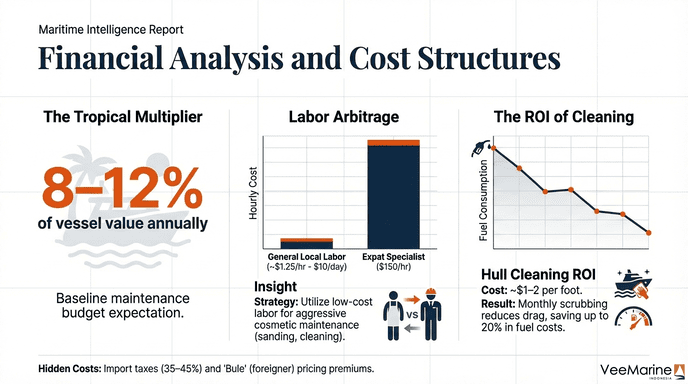
While Indonesia is often perceived as a low-cost country, yacht maintenance presents a mixed financial picture. Labor is inexpensive, but parts and specialized expertise are at a premium.
8.1 Labor Rate Benchmarks
- General Labor (Cleaning, Sanding, Polishing): IDR 100,000 – 150,000 per day (approx. $7 – $10 USD). This allows for aggressive cosmetic maintenance (varnish, wax) at a fraction of Western costs.
- Skilled Mechanic (local): IDR 150,000 – 250,000 per hour ($10 – $16 USD).
- Specialist Expat Technician: Charged at international rates ($100 – $150 USD/hour) plus travel/accommodation expenses.
8.2 Routine Maintenance Costs
- Hull Cleaning: Diver cleaning is highly affordable. Rates average IDR 15,000 – 30,000 per foot ($1 – $2 USD/ft). A 50ft yacht can be scrubbed for ~$75 USD. Frequent cleaning (monthly) is a high-ROI activity, saving significant fuel costs.
- Berthing: Rates are generally lower than the Mediterranean but higher than Malaysia. Expect $1.00 – $1.50 per foot/day in prime marinas like Benoa, with discounts for long-term stays.
9. Safety and Emergency Protocols
In the event of a catastrophic failure (fire, sinking, medical emergency), the “safety net” in Indonesia is thinner than in developed nations. Self-sufficiency is paramount.
9.1 Emergency Response Architecture
- BASARNAS (National Search and Rescue): The primary agency. Contact via 115. They are professional and capable but response times are dictated by the tyranny of distance. In remote areas (e.g., Banda Sea), a response may take 12–24 hours.
- Medical Evacuation: For serious trauma or decompression sickness, local clinics are often insufficient. Air evacuation to Singapore, Darwin, or Bali is the standard protocol. DAN (Divers Alert Network) or equivalent comprehensive insurance is mandatory for all crew and guests.
- Police (Polairud): Marine Police can be contacted on 110. They handle security and crime but are less equipped for technical rescue.
9.2 Vessel Preparation
- Fire Fighting: Standard dry powder extinguishers are often insufficient for engine room fires in remote locations. Carrying a portable gasoline-powered crash pump (high volume water pump) is standard practice for seasoned cruisers.
- Communications: GSM coverage is surprisingly good near islands, but satellite communication (Starlink/Iridium) is non-negotiable for offshore transits.
10. Conclusion and Strategic Recommendations
Maintaining a vessel in the Indonesian archipelago is an exercise in logistical endurance and technical adaptation. The environment is relentlessly aggressive, actively degrading metal, wood, and plastic 24 hours a day. However, the rewards—cruising the most biodiverse and culturally rich waters on the planet—are unmatched.
Strategic Recommendations for Owners and Captains:
- Tropicalize Maintenance Intervals: Discard manufacturer schedules designed for temperate climates. Halve the service intervals for raw water impellers, anodes, and heat exchanger cleaning.
- Embrace Local Wisdom for Phinisies: If operating a wooden vessel, respect the material science of Ironwood. Use flexible caulking and oils; avoid the temptation to “seal” the boat with epoxy, which invariably leads to structural rot.
- Master the Logistics: Do not fight the “Red Line.” Build a relationship with a competent yacht agent and budget for their fees as a standard operating cost. Use Singapore as your forward operating base for parts.
- Prioritize Cooling: The primary cause of mechanical failure in Indonesia is overheating. Daily strainer checks during the wet season and aggressive descaling of coolers are the cheapest insurance policies available.
- Defend Against the Sun: UV degradation is the silent destroyer. Invest heavily in canvas covers for every exposed surface (winches, hatches, tenders). The cost of canvas is far lower than the cost of replacing checking gelcoat or degraded teak.
By adopting this proactive, localized maintenance philosophy, operators can transform the challenge of the Indonesian maritime environment into a manageable routine, ensuring safety, reliability, and asset preservation in the Ring of Fire.

vm_admin